
One of the key measures a brand will use to assess how attractive or viable a sport and its rights holders are is not only how many of the target audience it potentially reaches (sheer popularity) but also how efficient it is at reaching them.
In other words, how much of that audience is relevant and irrelevant.
The first point is obvious but the second tends to get less airplay. However, it’s important because it relates to ‘wastage’. That is, how much will a brand spend on reaching people who are irrelevant to what is being promoted?
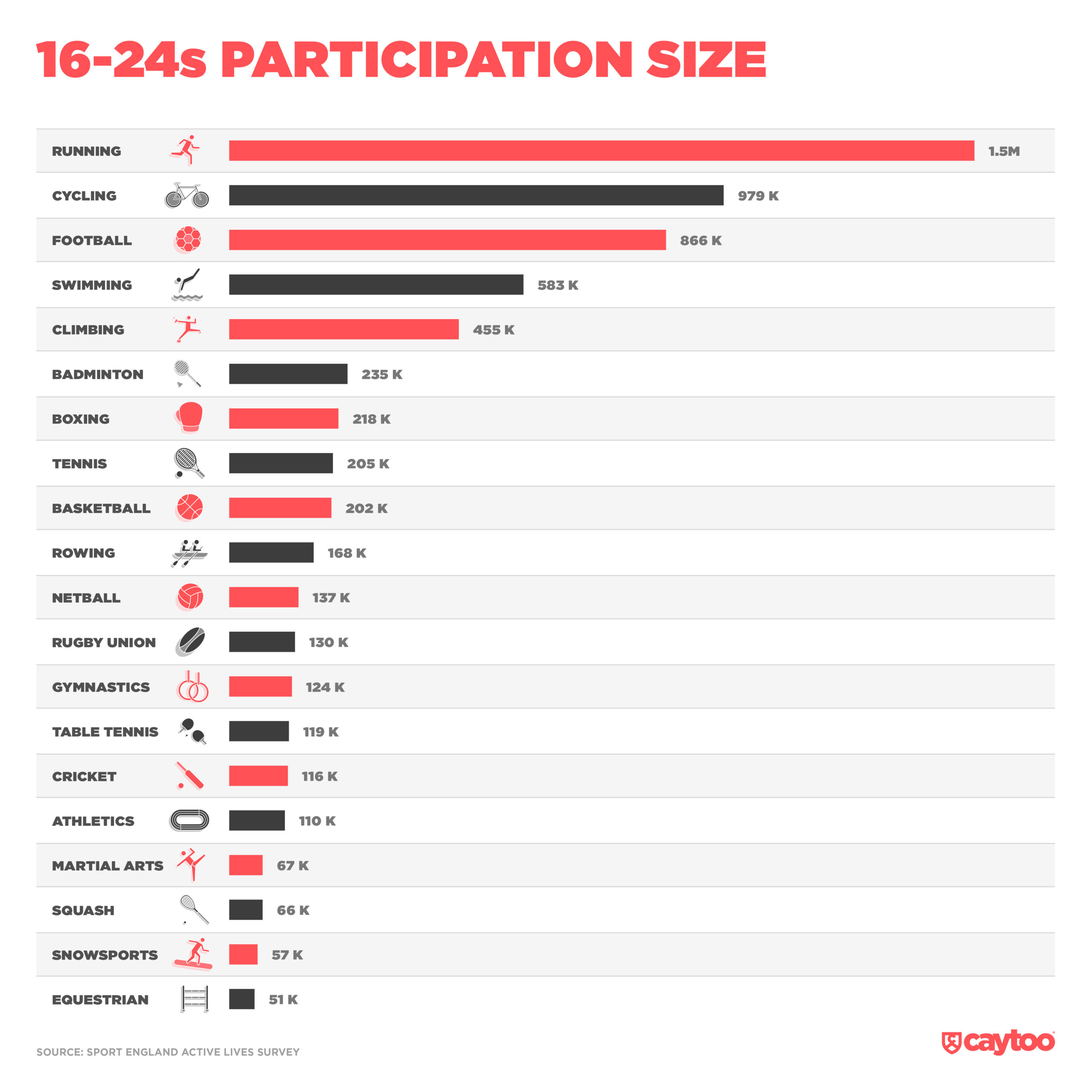
Take the example of brands wanting to target a sport in terms of how good it is at reaching Generation Z participants (those roughly 10-25 years old). We analysed data from Sport England’s Active Lives Survey to see which sports are best at reaching 16-24 year old ‘players’.
As this graphic shows, running, cycling, football, swimming and climbing have the most participants in that age group. Therefore, they’re the most attractive in terms of the sheer number of 16-24 year olds they can potentially reach.
However, usually the bigger the vehicle, the higher the price tag. For example, Vauxhall was reportedly paying around £6 million a year for its Football Association sponsorship while Sky was reportedly paying circa £2.5 million annually to sponsor British Cycling before HSBC took over in 2017.
These prices are well beyond the reach of most brands and although these sponsors will be reaching huge numbers of their target audience, they’ll also be reaching lots of people who aren’t in the market. Be it buying a car in Vauxhall’s case or satellite TV, in Sky’s case.
These points are where the idea of efficiency (or relevant vs irrelevant) comes in. It is measured by the share, or concentration, the target group makes up of the entity’s audience.
For example, if the entire audience of a TV show are women and your target audience are female, the TV show would be 100% efficient at reaching that audience. There is no ‘wastage’ in terms of spend going on male viewers.
By share/concentration, dodgeball is the most efficient sport for reaching 16-24 year old participants; 70% of people who play it regularly are 16-24 years old. Only 30% are over 24. (NB: the Sport England data excludes people under 16).
As the graphic below shows, basketball (67%), rounders (63%), skateboarding (59%) and volleyball (58%) are the next most efficient sports at reaching 16-24 participants.

The point of this is that any rights holder can be attractive to a potential sponsor in different ways. While most can’t compete on sheer size or popularity, they can offer a smaller but highly concentrated audience – and probably at a much smaller price. This is where the rights holders in smaller sports can potentially trump a bigger sport and so should be looking at promoting their share/concentration/efficiency metric.
To illustrate the point above, I’m going to use a ridiculously over-simplistic example (sponsorship involves WAAAAYYYY more than just reaching participants).
Let’s hypothetically say it costs £75k to sponsor the UK Dodgeball Association and compare this to the circa £6m for the Football Association. And let’s say a brand is only interested in targeting 16-24 participants. The sport of dodgeball offers 36,880 in this group but 15,591 who aren’t (the 70% share/concentration/efficiency). Football offers 865,640 16-24s but 1.23 million who aren’t (the 41% share).
Thus, UK Dodgeball costs £2.03 per 16-24 participant, more than three times cheaper than the FA’s £6.93. The sponsor would be ‘wasting’ £22,212 with UK Dodgeball but over £3.5 million with the FA.
Again, this is overly simplistic and isn’t at all saying sponsoring the FA is not a good idea. It’s simply to illustrate how smaller rights holders need to be more creative in the way they analyse their assets and package them up for potential sponsors. Particularly in using data and metrics that show smaller sports can potentially be a smarter investment choice than the bigger ones.
For further insights on targeting younger audiences see How to hook Generation Z: killer collaboration ideas for rights holders.
Prior to co-founding caytoo, Alex was an Analyst and VP of Global Communications at Nielsen and founded the successful PR/communications consultancy, Meteor.
To learn how caytoo’s actionable sports marketing insights can help your business fill out the form at the bottom of this page or contact Jeremy on 020 3176 8131 or jeremy@caytoo.co.uk
